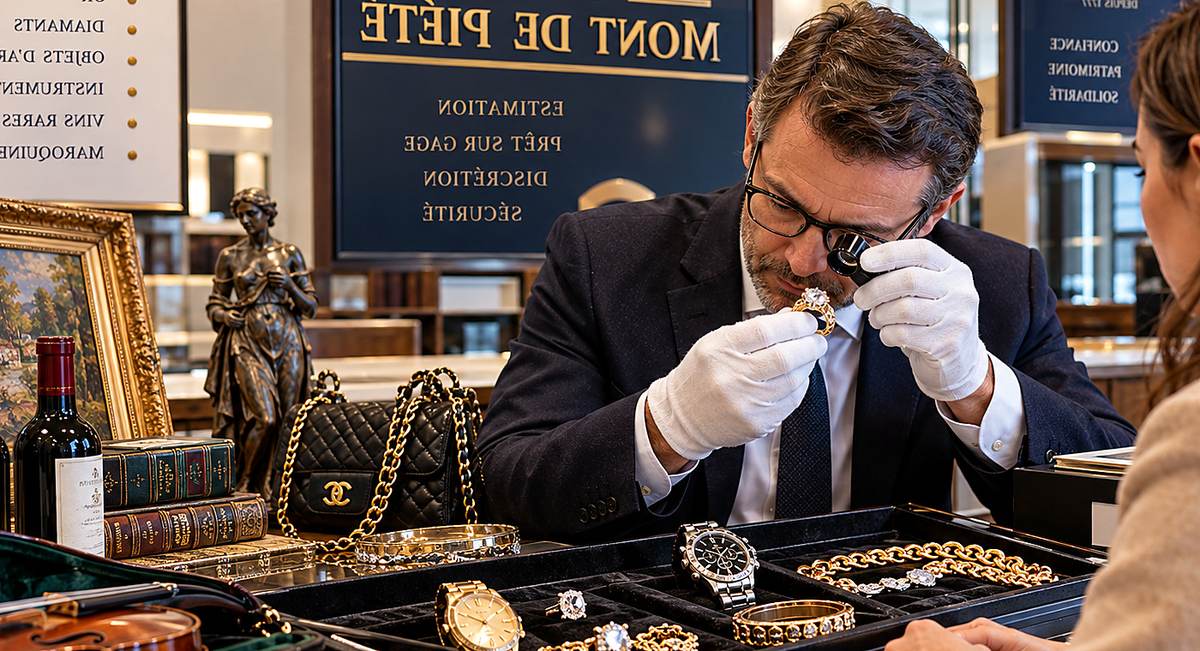
First criterion: resale value at auction
Institutions value each item according to the price it would fetch at public sale, not according to what you paid for it. The Crédit Municipal de Toulon sums it up: any object with value on the public auction market can be deposited.
Second criterion: flawless condition
Article D514-1 refers to goods of significant value in good condition. In practice, Paris refuses stained or heavily worn clothing and leather goods, and Bordeaux rejects any odd or worn piece of silverware, even if the metal itself remains precious.
Third criterion: signature or brand
For many categories, a signature makes the difference: Paris only accepts silver jewellery if it is signed, and the same applies to glassware, pens and lighters. An item with no identifiable brand will mainly be valued for its material.
Fourth criterion: proving the item is yours
Service-Public mentions proof of ownership for some items, and Paris may require any document establishing your rights. For a designer handbag, an invoice in your name is essential; the full list is on the page about documents needed for a pawn loan.
Check your institution's list first
Before setting off, compare your item with the list published by the nearest institution. The Paris list serves as a benchmark, but Bordeaux refuses rugs that Paris accepts, which is why it pays to consult the items accepted as pledges in France.
Categories that require an appointment
Strasbourg takes jewellery and watches freely, but asks for an appointment with the auctioneer for paintings, sculptures, wines, rare books, instruments or leather goods. In Nîmes, designer watches are appraised free of charge during a monthly valuation day.
Testing your gold with the Paris simulator
For gold, the Crédit Municipal de Paris offers a simulator based on weight in grams and fineness in carats, from 9 to 24. It does not cover gemstones, whose value requires an on-site appraisal by the institution's experts.
What rules an item out immediately
Certain materials are enough for an item to be refused: fur, ivory and elephant hair on the Paris list, big cat claws or teeth according to an interview published by Paris, and coral in Bordeaux. An antique jewel or figurine containing them will therefore be turned down.
Electronics and vehicles: check before you come
No institution consulted names smartphones, Toulouse only referring to connected devices, and vehicles fall under the offer specific to Nantes and Dijon. The particular conditions are set out on the page about pawning a smartphone.
Fragility and storage: a risk to weigh up
The Paris general terms exclude any compensation for damage caused by insects, worms, oxidation or changes in temperature. An old fabric or a silver piece prone to tarnishing therefore deserves some thought before you deposit it.
What the guarantee is worth if the item is lost
If the institution loses the item, Paris pays the valuation set at deposit plus a flat-rate compensation of 25%, minus the sums owed. Check the amount entered on the valuation slip, described in valuing a pledged item.
Accepted does not mean generously financed
An accepted item may attract only a modest sum: Paris cites a handbag bought for 1,200 euros, valued at 800 euros, against which you can borrow about 480 euros. Until the contract is signed, you remain free to decline the offer and leave with your item.
Where to check whether your item is accepted
- Crédit Municipal de Paris: Publishes the reference list, a gold simulator and the compensation rules if an item is lost.
- Crédit Municipal de Toulon: Links acceptance to the item's value on the public auction market, with branches in Ajaccio and Bastia.
- Crédit Municipal de Nîmes: Holds a free monthly valuation day by appointment for designer watches.
Checking whether your item is accepted
- Identify exactly what the item is, its material, brand and period, then note any visible hallmark or signature.
- Compare that description with the list and the refusals published by the nearest institution.
- For gold, run an online simulation based on the weight and the fineness in carats.
- Call or check with the institution to find out whether the category needs an appraisal appointment.
- Gather proof of ownership and the original accessories that make authentication easier.
- Present the item to the appraiser and decide once you know the amount offered.
What the valuation can yield
| Scenario | Possible amount | Source |
|---|---|---|
| Item in gold, silver or platinum | Up to 4/5 of the valuation | Article D514-8 CMF |
| Other accepted item | Up to 2/3 of the valuation | Article D514-8 CMF |
| Stated practice in Paris | Generally 50% to 80% of the valuation | Crédit Municipal de Paris, 2026 |
| Stated practice in Strasbourg | 50% to 70% of the valuation | Strasbourg, page dated 22 July 2023 |
| Appraisal at the counter | According to the institution's schedule | Each institution's conditions |
Items that strengthen your file
- Purchase invoice in the depositor's name
- Certificate of authenticity or warranty card
- Original box, case or packaging
- Laboratory certificate for a gemstone
- Valid identity document
Common reasons for refusal
- Confusing sentimental value with market value: a family heirloom with no outlet at auction will not be accepted.
- Presenting unsigned silver jewellery in Paris, where only silver jewellery bearing a signature appears on the list.
- Arriving without an appointment with a sculpture or a book collection at an institution that requires one for such items.
- Overlooking ivory or coral in an antique setting, a reason for refusal regardless of the quality of the rest.
- Relying on another institution's list without checking that of the branch you are actually visiting.
Your item before the appraiser
How do I know whether an item has value for a pawn loan?
Institutions think in terms of the likely hammer price. A signed item in good condition that is sought after in the saleroom has every chance. For gold, the Crédit Municipal de Paris simulator gives a first idea; for everything else, only the appraisal at the counter decides.
Can I have an item valued without pawning it?
Yes, the loan offer commits you to nothing until the contract is signed. In Nîmes, designer watches are even appraised free of charge during monthly valuation days, by appointment with an auctioneer.
Why has the Crédit Municipal refused my item?
The most common reasons are a resale value that is too low, poor condition, no invoice for leather goods, or an excluded material such as fur or ivory. The category may also simply not appear on that institution's list.
Can an inherited item be pawned?
Nothing in the pages consulted forbids it, but the institution may ask for any document proving your rights over the item. For something received through an inheritance, a certificate of succession or a notarial inventory may satisfy that request, to be confirmed with the institution.
Official sources
Service-public, qu'est-ce que le prêt sur gageservice-public.gouv.fr
Conditions générales du prêt sur gage, Pariscreditmunicipal.fr
General information, up to date as of October 2026 and non-contractual: always check the terms with the Crédit Municipal or the institution concerned.