Who is allowed to lend against jewellery
The Code monétaire et financier reserves lending against physical pledges for the municipal pawnbroking institutions, governed by articles L514-1 to L514-4 and then D514-1 onwards. A jeweller who buys your ring concludes a sale: you lose the item for good.
Jewellery accepted on rue des Francs-Bourgeois
The Crédit Municipal de Paris accepts jewellery in gold or platinum, silver pieces provided they are signed, and designer jewellery. An unsigned silver chain is therefore likely to be refused at the Paris counter, however flawless its condition.
14 and 18 carat gold, mounted pearls: the Bordeaux list
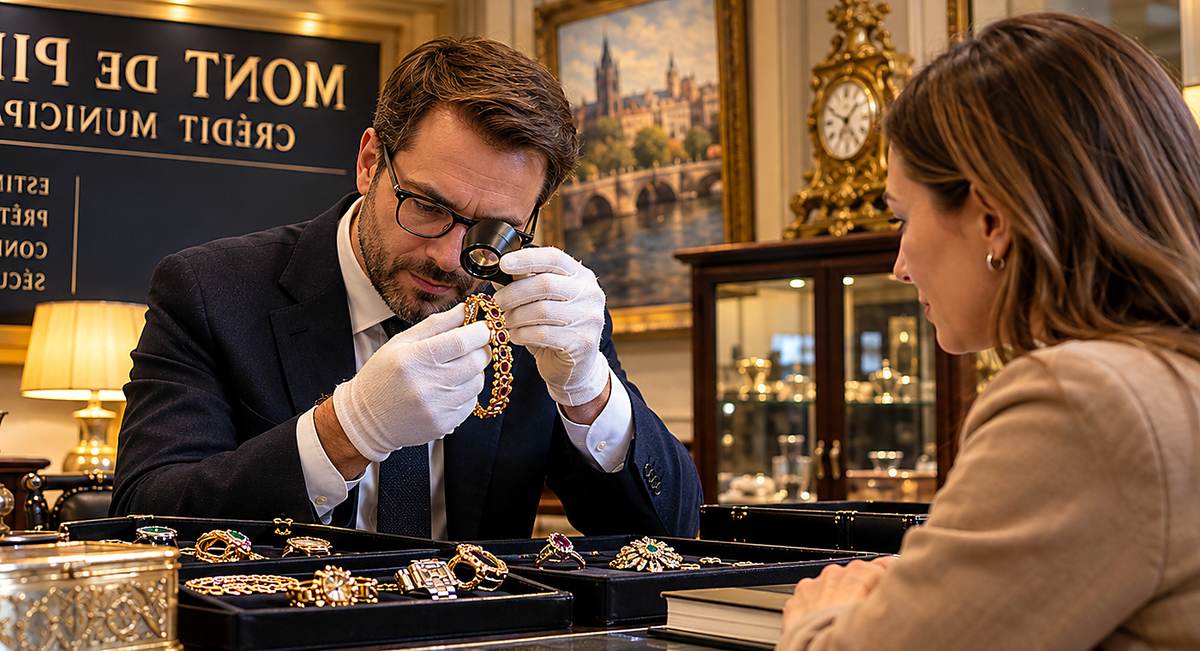
The Bordeaux institution lists necklaces, bracelets, rings and earrings in 18 or 14 carat gold, as well as natural or cultured pearls mounted as a necklace or bracelet. Its appraiser checks the stones with a gem tester and a refractometer.
Metal by weight, stones apart: two ceilings
According to the Bordeaux tariff sheet of 15 November 2022, gold, silver and platinum valued by weight can be lent against up to four fifths of the valuation, everything else up to two thirds. A solitaire falls under the second ceiling, like any pawn loan on diamonds.
What share of the value to expect
The Crédit Municipal de Paris quotes around 60% of the estimated value, up to 80% for certain items; Bordeaux mentions 40 to 75% depending on the piece and the gold price. The valuation follows auction results, never the shop receipt.
The cost of pawning jewellery in Paris
On its rates page, the CMP displays an APR of 4.25% between €30 and €500, 9.90% up to €6,000 and 5.30% above that. The scales of the other institutions are compared in the guide to the pawn loan interest rate in France.
Six months or a year: terms and extensions
Paris grants a one-year renewable loan; Bordeaux and Nîmes lend for six months, extendable up to twenty-four months; Toulouse renews by half-year if the interest is paid. On a Paris renewal, a lower revaluation obliges the borrower to repay the excess.
Walk-in deposits and payout
At the CMP, jewellery can be deposited without an appointment in the morning and by appointment in the afternoon, with the loan promised in under an hour. Since 1 December 2024, Paris pays up to €3,000 in cash and the remainder by bank transfer.
Specific rules in Toulouse, Toulon and Corsica
In Toulouse, the rue des Lois branch caps loans on jewellery or gold agreed between 1 pm and 2 pm at €1,000. The Crédit Municipal de Toulon pays out immediately, has branches in Ajaccio and Bastia and does not accept a driving licence as identification.
When the jewellery is not redeemed
Without repayment or renewal, the piece goes to auction. The CMP holds sales dedicated to jewellery and watches, for example in June and December 2025, deducts 15% in sale fees and keeps the surplus available to the borrower for two years.
How many pieces return to their owners
The Crédit Municipal de Nîmes states that 96% of the items it takes in pledge are redeemed and that any shortfall at sale is borne by the institution. In Paris, the house leather goods expert speaks of roughly nine loans in ten being repaid.
Loss of the piece and no cooling-off period
The Paris general terms dated 1 May 2026 provide, if the item is lost, for the valuation at deposit plus 25%, minus the sums owed. There is no right of withdrawal: reread the pre-contractual information required by the decree of 29 April 2011.
Institutions that accept jewellery as a pledge
- Crédit Municipal de Paris: Accepts gold, platinum, signed silver and designer jewellery; one-year loan, 55 rue des Francs-Bourgeois.
- Crédit Municipal de Bordeaux: Takes 14 and 18 carat gold and mounted pearls; six-month loans extendable up to two years.
- Crédit Municipal de Toulouse: Branch on rue des Lois and gold and jewellery appraisal in Montauban, with half-yearly renewal.
- Crédit Municipal de Toulon: Walk-in jewellery deposits, branches in the Var and Corsica, money handed over immediately.
- Crédit Municipal de Nîmes: Six-month loans renewable up to two years; 96% of pledged items are redeemed there.
Pawning a piece, from drawer to counter
- Gather the piece and its invoice or certificate if one exists, then check the institution's list to confirm the metal and signature are accepted.
- Go to the counter, without an appointment in the morning in Paris, with identification, proof of address and bank details in your name.
- Let the appraiser weigh the metal, read the hallmarks and test the stones, then hear the amount offered before deciding.
- Sign the contract after reading the pre-contractual sheet, keep the pawn ticket and note the due date.
- At maturity, repay principal and interest to collect the piece, or pay the accrued interest to renew the loan.
- If the auction has taken place, claim the surplus with bank details and identification within two years.
Paris scale applied to jewellery
| Amount lent | APR displayed by the CMP | Note |
|---|---|---|
| €30 to €500 | 4.25% | No storage fee charged |
| €501 to €6,000 | 9.90% | Including 1% storage fee |
| €6,001 and above | 5.30% | Proof of income from €10,000 |
| Late payment | 0.50% per fortnight | Capped at 12 fortnights (terms 01-05-2026) |
| Auction sale | 15% of the hammer price | Surplus claimable for two years |
Documents requested for jewellery
- Photo identification
- Proof of address in France
- Bank details for a personal current account
- Invoice or certificate for the piece
- Tax notice (Nîmes, above €7,500)
- Proof of income (Paris, from €10,000)
Common missteps with pawned jewellery
- Bringing unsigned silver jewellery to Paris, where only silver pieces bearing a signature appear on the list of accepted items.
- Confusing a pawn loan with selling to a gold-buying counter, which transfers ownership of the piece immediately and permanently.
- Expecting a sum close to the purchase price, when the valuation rests on public auction results and the loan is only a fraction of it.
- Letting the due date pass without renewing: late penalties build up fortnight by fortnight, then the piece is entered in a sale.
- Forgetting to claim the surplus after the sale, although in Paris it passes permanently to the institution after two years.
Your questions about pawning jewellery
How much does a Crédit Municipal lend on a gold piece?
It depends on the weight, the carat fineness and the metal price. Paris quotes around 60% of the estimated value, sometimes up to 80%, and Bordeaux caps precious metals valued by weight at four fifths of the valuation according to its 2022 sheet.
Can costume jewellery be pawned?
As a rule, no: the institutions only lend on items that have a value on the public auction market. Paris does, however, accept designer jewellery, and a silver piece is only taken there if it is signed.
Is an invoice needed to pawn jewellery?
For gold and classic jewellery, the on-site appraisal is usually enough, but an invoice or certificate makes the valuation easier. For a diamond, Bordeaux requires a laboratory certificate and Nîmes may ask for appraisal certificates for certain items.
What happens to pawned jewellery that is not repaid?
It is sold at public auction after the due date. At the Crédit Municipal de Paris, sale fees amount to 15% of the hammer price, the debt is settled and any surplus (boni) remains available to the borrower for two years.
Can the loan be repaid early?
Yes. Article D514-7 of the Code monétaire et financier allows a pledge to be redeemed before term, and the Crédit Municipal de Paris then calculates interest pro rata temporis, with no early repayment penalty whatsoever.
Official sources
Principes et modalités des prêts sur gage, articles D514-1 à D514-9legifrance.gouv.fr
Bordereau de renouvellement d'un gage sans dépossessionservice-public.fr
Annuaire de l'administration, Crédits municipauxlannuaire.service-public.gouv.fr
General information, up to date as of October 2026 and non-contractual: always check the terms with the Crédit Municipal or the institution concerned.